
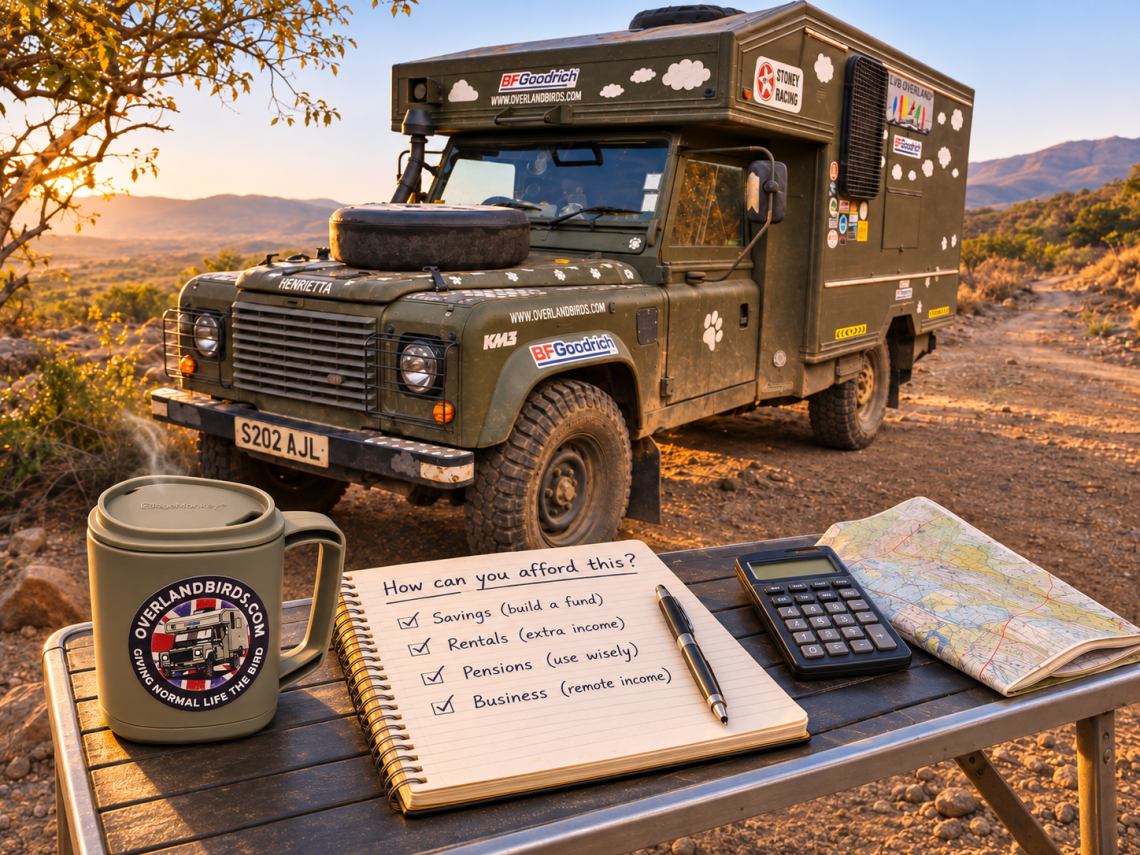
How Can You Afford This
Money, Money, Money… Aha-ahaaa!
How do you afford to give up work and spend years travelling around the world?
That’s probably one of the questions we’ve been asked most often. And the answer has changed quite a bit over the years.
We started with savings, redundancy money (or rather, the redundancy money we thought we were getting), and a budget that looked frighteningly large. Later came rental properties, small businesses and, eventually, pensions.
It hasn’t always gone to plan. There have been times when we were counting every £60 because that represented another day on the road. At other times, things have been considerably more comfortable.
Here’s how we made it work, including the mistakes, the panics and the occasional bit of luck.
November 2026 — retired, still in Asia, and planning the next adventure
We’re still in Asia, but we’re already planning the next trip to foreign lands — and this time we’ll be buying another vehicle to do it in. Henrietta is back in the UK, retired and in storage.
We’re both fully retired now. Our house has been sold, and our future home is still rented out and bringing in money. Meanwhile, we’ve started applying for visas, having medicals and dealing with all the other bits and pieces that come with planning another big trip.
We’ve also sold the businesses, so that’s one ongoing headache gone. They weren’t too difficult to manage when we had internet, but where we’re planning to go next we might not have any connection at all. So they had to go. The new owners are going to keep everything the same — or at least I hope they do. I’ve always taken pride in customer service and quality, and I’d like that to carry on.
We’ve spent a great deal of time working out the budgets for the next adventure. And yes, we’re still recording every penny of what we spend. Literally. If something costs 1p, it goes on the sheet. When I give 50p to the disabled guy, that goes on too.
We use an app to record everything these days, which makes the job much easier — apart from dealing with the exchange rates. Some habits never change.
Where we stood in August 2025
(Posted 11/08/2025)
Lots of changes to the budgets and finances since my last update here. Pensions are being claimed. Houses are being sold. The small business is still running. We’re actually now financially stable and have more cash now coming in than since we worked. It’s crazy, and as we are not really moving at the moment, we are doing OK. Our “home” is in storage and we are living temporarily in Asia, moving around a bit using public transport. Our proper home in the UK is just going through sale and once that’s done we won’t know what to do with all that cash. Live it up a bit I guess. The kidney is off the market.
The original plan — 2011
(Posted 31/07/2011)
I’ve been trying to plug the holes other travel blogs leave. I’ve read them for years, planned this for about two, and I still find the same unanswered question: how do you actually afford this? It’s not just the upfront cost of upping sticks and leaving the UK. There’s pensions, tax, savings, whether you’ll have a job when you crawl back, and a dozen other fun administrative goblins I’ve probably not met yet.
So how can we afford it? I’ve had some decent jobs over the years. Jelly was with the same company for 21 years and then got made redundant. The plan was simple: use her big redundancy lump sum to fund two years — roughly £40,000 before any sensible words like “contingency” got a look in.
And then the company went bust. Cheers. That left Jelly with the government minimum — about five months — which isn’t quite two years no matter how you squint at it. We’re not selling the house, and with no income while we’re away, I started asking myself the same question you’re asking me.
The unglamorous truth: we’ve been saving like maniacs for years. We had good jobs (past tense doing a lot of heavy lifting there), didn’t splurge on shiny nonsense, still took holidays and enjoyed ourselves, but we saved and saved again. I’ve been made redundant twice and once managed to lose redundancy money on shares — sterling work — but we kept the saving habit.
The working budget for a two-year run: £20,000 per year to live, £25,000 on the car, and £10,000 for contingency. Total: £75,000. We spread the car costs over two years and chipped in savings to finish it. The rest took about a decade to stash away — call it £7,500 a year. As for pensions: I could die tomorrow, so why worry… though I may feel differently in 25 years. Tax on rental income while you’re not in the UK? That little joy gets its own spot on the planning pages.
When every £60 meant another day on the road — September 2011
(Posted Sept 2011)
Funds are getting low — anyone in the market for a slightly used kidney? Every £60 we spend is one less day on the road. This month alone, we’ve “saved” ourselves 25 days… by losing them. No job = no income = spending money that isn’t replaced = the trip quietly eroding under our feet. Time to get moving, shall we?
What we learned — 2017
(Posted 19/09/2017)
Lesson from the first big trip: don’t burn through your capital like it’s kindling. The bright idea was to have investment properties, live off the rent, and only nibble at capital when absolutely necessary. Revolutionary, I know.
Next time around the aim was rental income of about £1,500 a month. Not as flexible as sitting on a glorious pile of cash, but enough to keep wheels turning indefinitely if we stay frugal. You still need an emergency float because breakdowns and “surprises” happen — and getting home from somewhere far-flung isn’t exactly bargain-bin pricing.
At that point it was mostly a plan — funds weren’t there yet — but we knew people who were doing exactly this, so it clearly can work.
Living on a tight budget — 2020–2023
(Posted 20/09/2020, revised 07/07/2023)
We did what we said we would. We paid off the main house, bought a smaller, cheaper one, and now rent both. We live off the income. It’s… tight. Same as anyone: money in, bills out, and if you’re lucky there’s something left to save. We’re not currently acquainted with “lucky.” After admin and maintenance, we’re below what you could live on in the UK without creative accounting or a taste for air sandwiches.
We don’t pay tax because we don’t earn enough to hit the threshold. If we claimed UK benefits, we’d have more coming in. Does that paint the picture? Regardless, we’re full-time on the road and making it work with a fixed budget and stubbornness.
(Updated 07/07/2023)
I also run a small remote business making Land Rover windows. It’s “pocket money,” but without it we’d be in a proper mess. I had a sticker business that covered about 30% of the trip, but a crucial part of the operation became impossible, so I sold it. That nearly ended the whole adventure, but here we are — still moving, still solvent (just), and still counting days by how many £60 notes we don’t spend.
What the trips actually cost
We’ve now put the recorded expenditure from both trips together, along with the costs of buying and preparing Matilda and Henrietta. You can see the figures on The Costs page.