
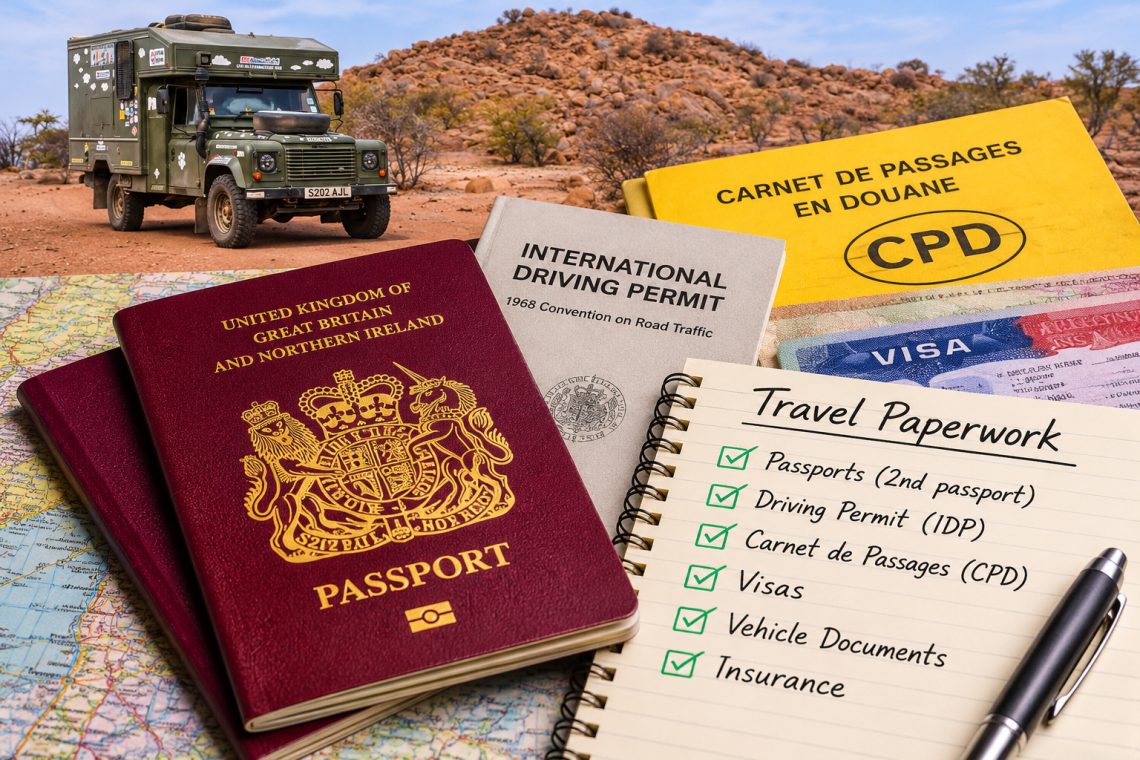
Paperwork
Paperwork — passports, permits and the never-ending bits of paper
If you thought preparing a Land Rover for a long overland trip was complicated, wait until you start on the paperwork. Passports, visas, driving licences, vehicle registration documents and permits all come with their own little surprises.
These are our experiences and notes from earlier trips, mostly written between 2011 and 2013. Requirements and laws can change, so they’re a record of what happened to us, not instructions for travelling today.
Second passports — 3 August 2011
Our second passports arrived on 3 August 2011. Technically, they were our first additional passports, and the applications were treated like new passport applications.
I completed the forms online and sent them off with a letter from my company explaining why I needed another passport for increasingly frequent travel. There were new photographs, birth certificates and family documents to dig out. Because J’s parents were no longer with us, we needed extra information about them. For my parents, they wanted passport details to establish our British nationality. The fact that we already had UK passports apparently wasn’t enough. They wanted to check we were still British!
Each additional passport cost us £93.50 at the time. We wanted them because some visa applications would involve sending a passport back to the UK while we were still travelling. Having another passport meant we could potentially keep moving while family helped with the paperwork and courier arrangements. It was also something we considered useful for complicated travel routes involving Israel.
I’d rather have an extra passport and not need it than the other way round. Whether an additional passport can be issued, and what evidence is needed, must be checked against the current rules.
Driving licences and international driving permits
We encountered corrupt police officers many times on our travels, and handing over an original driving licence could mean not getting it back without paying a bribe. That wasn’t a theoretical worry; it was something we had to deal with on the road.
Our answer was to carry good-quality, laminated copies of our driving licences that looked very much like the originals, alongside the genuine documents. We bought laminating pouches and self-adhesive holograms to make the copies more convincing. The point, from our perspective, was to avoid losing the genuine licences to someone determined to hang on to them.
You could also obtain an official replacement licence from the DVLA, but that didn’t solve our concern about a police officer keeping it. We were travelling in places where an ordinary roadside document check could become a negotiation. Having a copy to hand was an important part of how we dealt with that.
We also carried international driving permits (IDPs). In roughly 20 months, we were asked to produce one only about twice. That’s simply what happened to us, not a statement about today’s requirements.
International Certificate of Motor Vehicles (ICMV)
The International Certificate of Motor Vehicles looked about as official as a fag packet to me. It was supposed to help explain or translate the V5C registration details, but nobody ever asked us for it. Not once. In the end, it was an expensive bit of paper we never used.
What we actually used, almost everywhere, was a good laminated copy of the V5C. We hardly ever needed to get the original out.
I can remember using the original V5C once in Europe and once in Botswana, when we officially imported the vehicle and dealt with its Botswana registration. The officials in Botswana wanted to keep the original. I refused, because we were also keeping the vehicle registered in the UK.
That experience explains why we were so keen to protect our original paperwork. The ICMV was of no practical use to us; the V5C copies, on the other hand, were used constantly.
Copies, originals and dealing with bureaucracy
I’ve said to other overlanders that you practically need to become a master forger to get through all the paperwork. I’m being provocative, but the experience behind the joke was real: we encountered corrupt police many times, and an officer keeping an original licence or registration document could leave us with a serious problem.
We carried convincing laminated copies of the driving licences and V5C, while keeping the originals safe. The copies weren’t just for our filing cabinet — we used them regularly on the road. In some African countries we could also get a photocopy of the vehicle registration officially stamped by the police, and we had several of those.
The idea wasn’t to change the details on a document. It was to avoid having an original taken from us. I wouldn’t pretend that the legal position was the same everywhere, but I can say clearly that carrying those copies was essential in our experience.
It’s easy for someone who hasn’t dealt with corrupt officials on remote roads to say ‘just show the original’. We often had to weigh that against the risk of never seeing it again. Botswana’s attempt to retain the V5C when we were registering the vehicle there was a particularly good reminder of why we were cautious.
Getting ready for the next trip — November 2026
We’re back at it again, preparing for another journey while still in Asia. Visa applications and medicals are already underway, with another vehicle and another set of countries to organise. Some things change, but the paperwork never seems to end.